

Communication Archiving vs Backup
Organizations invest in backup solutions to protect against cyberattacks, accidental deletion, and system failures. While backups are essential for business continuity, they serve a different purpose than communication archiving. For highly regulated industries, where records retention requirements extend beyond simply keeping copies of data, understanding that distinction is particularly important.
Financial institutions, healthcare organizations, insurance providers, government agencies, and other regulated organizations may be required to preserve certain electronic communications based on applicable laws, regulations, records-retention policies, and legal obligations
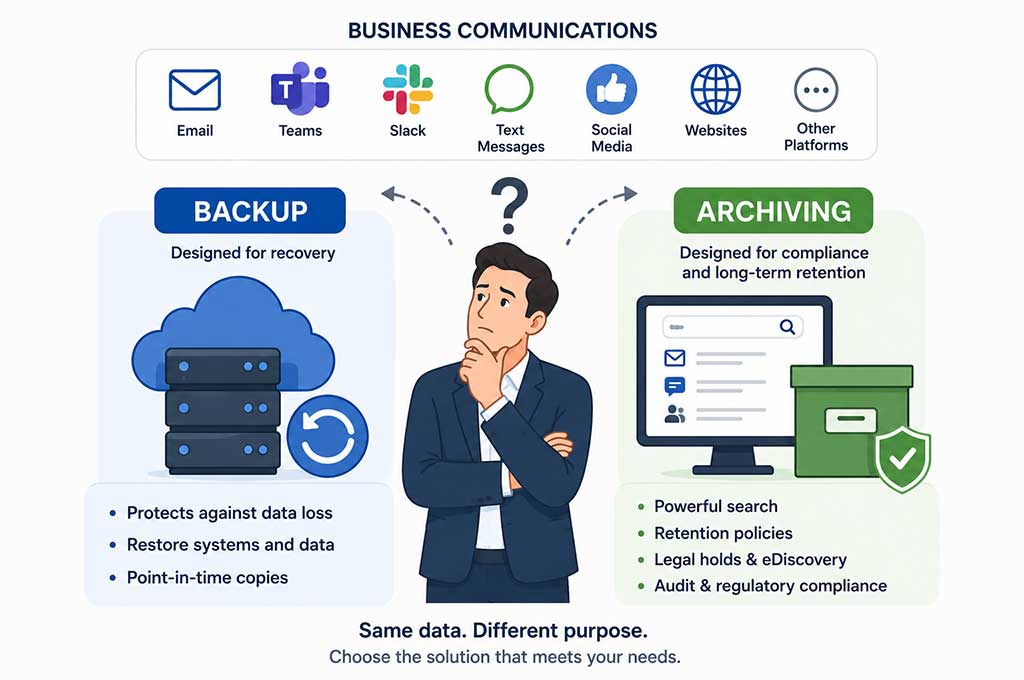
What Backups Are Designed to Do
Backups help organizations recover data after an unexpected event, such as ransomware, hardware failure, or unintentional deletion. Their primary purpose is to restore data, applications, and systems after an operational disruption.
Although backups are valuable, they generally are not designed to apply records-retention policies, provide efficient searches across years of communications, support legal holds, or satisfy specialized electronic-recordkeeping requirements.
What Communication Archiving Does
Communication archiving preserves business communications as records subject to established retention policies. Rather than creating periodic recovery copies, an archive automatically captures or collects in-scope communications and stores them in a secure, searchable repository for the required retention period.
Depending on an organization’s communication channels, an archive may need to include:
- Microsoft Teams
- Slack
- Text messages
- Social media communications
- Website content
- Other messaging and collaboration platforms
An effective archive allows for retrieval of communications by employee or custodian, keyword, date range, or other available search criteria while preserving metadata that may be required during audits, investigations, or litigation.
Why the Difference Matters
Regulated organizations are often required to produce records during audits, examinations, investigations, or litigation. For example, SEC Rule 17a-4 establishes preservation requirements for certain records maintained by broker-dealers, including applicable retention periods and requirements for electronic recordkeeping systems. FINRA Rule 4511 requires FINRA member firms to make and preserve books and records required under FINRA rules, the Securities Exchange Act, and applicable Exchange Act rules. It also requires records created under FINRA rules to be maintained in a format and media that complies with SEC Rule 17a-4.
Searching through backup files that were created for disaster recovery can be inefficient and may not provide the searchability or documentation expected during a regulatory review.
Common Misconceptions
Several misconceptions continue to create unnecessary compliance risk.
“Our cloud provider handles compliance.” – While many cloud platforms provide redundancy and recovery capabilities, organizations remain responsible for meeting their own recordkeeping obligations.
“We can always restore the data from a backup.” – Restoring an entire backup to locate a handful of communications is often time-consuming and may not satisfy legal or regulatory requests.
“We only need to archive email.” – Business communications increasingly occur across collaboration platforms, text messaging, websites, and social media. Depending on an organization’s policies and regulatory obligations, these communications may also need to be retained.
Building a Defensible Strategy
Backups and communication archives serve complementary purposes. Backups help organizations recover from operational disruptions, while archives support compliance, records retention, eDiscovery, and regulatory response.
As communication channels continue to expand, maintaining centralized, searchable records can improve audit readiness, reduce administrative burden, and simplify compliance and records-management efforts.
How MessageWatcher Helps
MessageWatcher helps organizations capture and archive communications across email, Microsoft Teams, Slack, text messaging, social media, websites, and other supported communication channels. Communications are securely preserved in a centralized, searchable archive, making it easier to apply retention policies, respond to audits, support eDiscovery, and produce records for regulatory requests.
MessageWatcher also provides communication-supervision capabilities, including policies that identify messages containing potentially concerning keywords and phrases. Together, these archiving and supervision tools support an organization’s compliance program while helping maintain complete, accessible communication records.
References
- U.S. Securities and Exchange Commission. SEC Rule 17a-4 – Records to Be Preserved by Certain Exchange Members, Brokers and Dealers. https://www.ecfr.gov/current/title-17/section-240.17a-4
- FINRA. Rule 4511 – General Requirements. https://www.finra.org/rules-guidance/rulebooks/finra-rules/4511
